
Ticket pipeline
What it does
Section titled “What it does”Every hour a scan claims the most important GitHub issues labelled ready-for-agent and hands each to a machine with a free slot. That machine builds the ticket in its own git worktree, measures the result against a baseline, checks that tests changed with the code, and runs a code review. Only a build that passes all three becomes a pull request, with the evidence in its description and Closes #n. Several run at once. As of 2026-11-02, 100 pipeline-written PRs have merged: 81 on G-Eskayo/marvin and 19 on G-Eskayo/clarity-captions (counted with gh pr list --state merged, head branch starting pipeline/).
When the work needs you (a design call, a login, a purchase), triage marks it ready-for-human. Use an interactive Claude Code session for that.
Why it exists
Section titled “Why it exists”Filing a ticket shouldn’t mean sitting there and driving Claude through it. The pipeline keeps working while you’re away, so it had to be safe to leave alone. Early unattended runs edited the real checkout, kept retrying an environment that was broken, and called tickets “too vague” when the model service was down. Each of those is now a guard in the code.
See it work
Section titled “See it work”The primary scanner’s run log, read 2026-11-02 on the Mac mini (trimmed; two private projects removed):
$ ~/.agents/venv/bin/python -c 'import json,osr = json.load(open(os.path.expanduser("~/.claude/logs/jobs/ticket-pipeline.json")))["runs"][-2]print(r["id"], r["status"], r["started_at"])for s in r["steps"]: print(" ", s["at"][11:19], s["step"], "|", s["detail"])'9e897f68 passed 2026-11-02T17:56:21Z 17:56:21 Code freshness | current: up to date with origin/main (as of the last fetch) 18:00:21 Ticket agents | 8 applied, 511 proposed, 0 failed 18:00:55 Conflicted PRs | none 18:00:57 Owner decisions | 12 PR(s) waiting on MARVIN 18:00:57 Circuit breaker | clear 18:01:23 Scanning tickets | 116 ready; next is #821 Docs: relative links inside documents do nothing 18:01:24 Choosing a machine | macbook-pro-1 18:01:24 Claiming ticket | #821 Docs: relative links inside documents do nothing 18:01:26 Dispatching | to macbook-pro-1 18:01:27 Scanning tickets | 116 ready; next is #827 Support: the request link loads GitHub inside the app window... 18:01:28 Choosing a machine | disk 12.2346 GB free on mac-mini-1, minimum 15One ticket went to the laptop. The next waited: the Mac mini was under its 15 GB disk guard.
How it works
Section titled “How it works”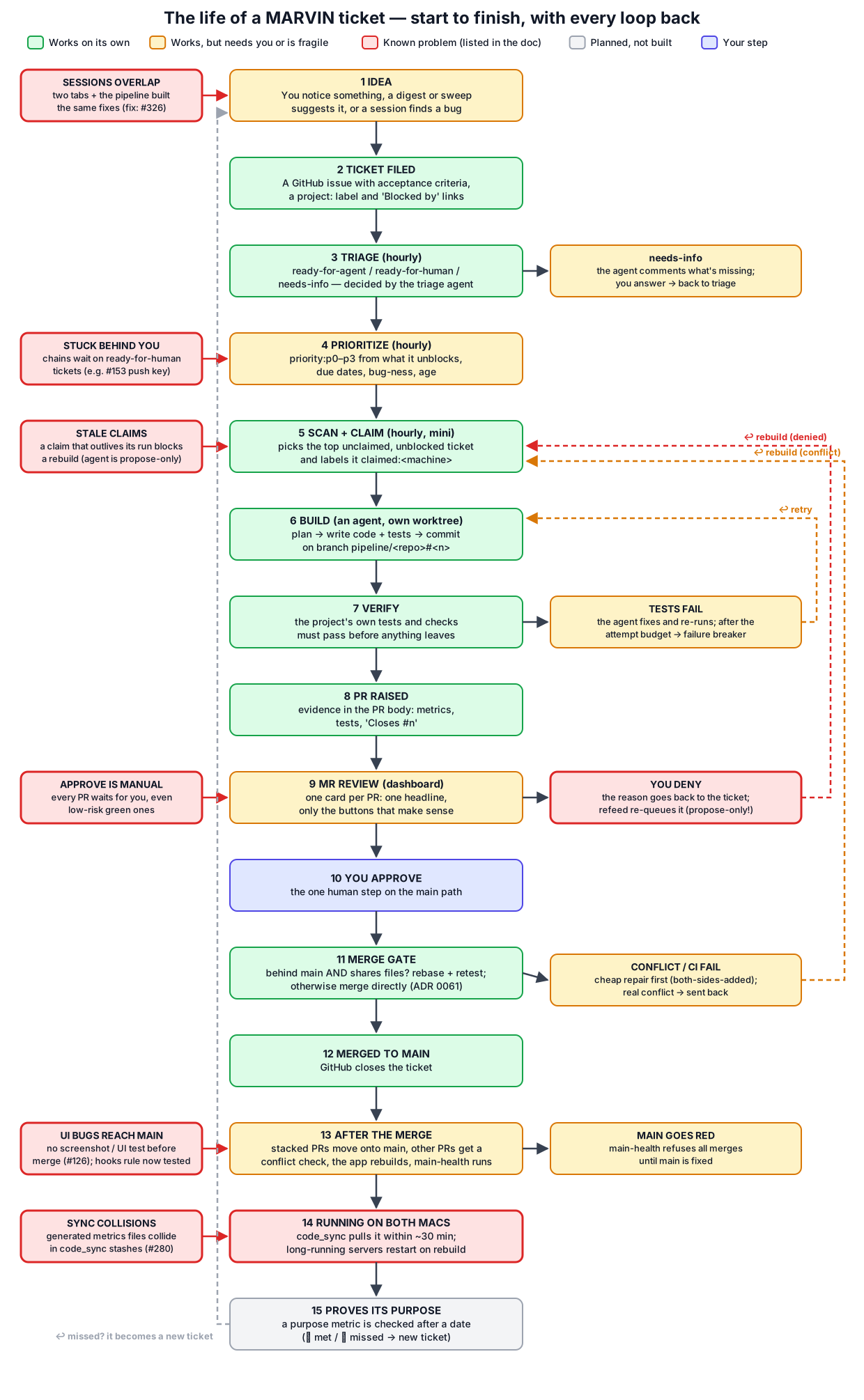
- Scan. launchd runs
lib/ticket_pipeline.pyhourly. The Mac mini is the primary scanner; another Mac scans only when the primary’s heartbeat is over 150 minutes old or says it’s paused (lib/scanner_role.py). No scan dispatches while this Mac’s own MARVIN code is stale or its code sync is stuck. - Claim. It reads ready, unclaimed, unblocked tickets across MARVIN and every project with dispatch on, orders them by priority, and labels each
claimed:<machine>with a run id, under a file lock. - Fill slots. With parallel dispatch on, it keeps starting tickets until a total, per-project or per-machine cap is hit. A machine is skipped, with the reason logged, when disk or the GitHub request budget is under its guard, the breaker is tripped, or a needed tool is missing (
lib/dispatch_concurrency.py). - Build in a worktree.
lib/run_ticket.pyruns on the chosen machine. A fresh worktree comes offorigin/mainon branchpipeline/<repo>#<n>; leftovers from an earlier attempt are saved underrefs/rescue/first, and a preflight proves the agent’s shell is in that worktree before any tokens are spent. - Plan, then execute. A flagship-model run with read-only tools writes a design doc and task list. A Haiku run edits files and runs tests. Both are headless
claude -pwithdontAskand an allowlist. Commits, pushes andgh pr createhappen in plain Python (lib/mr_raiser.py), never inside the agent. - Measure and check.
lib/metrics_registry.pycompares against the baseline, and onlyimprovedpasses. Code must ship with a test change, and a code review’s must-fix findings go back to the builder. Up to 3 rounds. - PR or retry. A pass opens the PR. A failure comments on the ticket, releases the claim with a backoff and logs the cause. Three failed runs in a row park the ticket for a person.
Each step writes a stage event to ~/.claude/logs/ticket-stages/. The dashboard draws them as a strip of pills on every PR and ticket card (claimed through done), marking a started stage as stalled after 10 quiet minutes, 35 for the merge gate.
The failure breaker
Section titled “The failure breaker”lib/failure_breaker.py reduces each failure to a signature such as verify-timeout or model-unavailable. When one signature hits 3 different tickets of a project within 2 hours with no success since, that project’s dispatch pauses and Health goes red. A success in that project clears it. One ticket failing repeatedly never trips it; that’s the per-ticket strike count’s job. This MacBook’s log on 2026-11-02 held 98 failures since 2026-10-08: verdict:unchanged 21, verify-timeout 17, verdict:code (code review) 8, verdict:mixed 7, model-unavailable 5, and 33 unclassified. Merge refusals go to the same file as refusal and never count.
Use it
Section titled “Use it”# Preview the next scan without claiming anything~/.agents/venv/bin/python ~/.agents/lib/ticket_pipeline.py --dry-run
# Build one ticket on this machine (a number, or owner/repo#number)~/.agents/venv/bin/python ~/.agents/lib/run_ticket.py 821
# Is dispatch paused, and why?~/.agents/venv/bin/python ~/.agents/lib/failure_breaker.py status~/.agents/venv/bin/python ~/.agents/lib/failure_breaker.py clear # after you fix the causeTo queue work, label an issue ready-for-agent. The scan’s steps show live in the dashboard’s Activity tab, and the parallel toggle sits in its device strip.
Configure
Section titled “Configure”| Setting | Where | Default / today |
|---|---|---|
| Scan interval | ~/Library/LaunchAgents/com.marvin.ticket-pipeline.plist, StartInterval |
3600 s |
parallel |
config/dispatch.json |
code default false; on in this install |
max_total, max_per_project |
config/dispatch.json |
defaults 2 and 1; this install 4 and 3 |
machine_slots |
config/dispatch.json |
defaults Mini 2, MacBook 1; this install 2 and 2 |
credit_slots |
config/dispatch.json |
extra slots that open only while that Mac’s API credit is ready |
guards.min_disk_gb, guards.min_github_budget_pct |
config/dispatch.json |
15 GB, 20% |
| Per-project dispatch, machines, test commands | config/projects/<name>.json in your instance repo |
dispatch off until set |
| Breaker window and threshold | WINDOW_HOURS, MIN_DISTINCT_TICKETS in lib/failure_breaker.py |
2 h, 3 tickets |
Limits take whole numbers from 1 to 8. An invalid field falls back to its default, and an unreadable guard never blocks dispatch.
Requirements and limitations
Section titled “Requirements and limitations”- macOS with launchd, Claude Code signed in,
ghauthenticated, and the MARVIN venv. The scan’s job is a launchd agent; a Linux node isn’t a scanner today. - Machine names are fixed in code (
mac-mini-1,macbook-pro-1), and the primary scanner is whichever host id starts withmac-mini. A second install with other hardware needs those changed. - A ticket the planner can’t turn into a concrete task list (
TOO_VAGUE) goes to a person. A test command outside the executor’s allowlist is refused. - Verification times out on a loaded machine; it’s the second most common failure above. Timeouts aren’t strikes, but 5 failed or timed-out runs in a row park the ticket.
- Every PR still waits for the owner’s Approve. Auto-merge for low-risk PRs runs in shadow mode only.
Design and source
Section titled “Design and source”- ADRs: 0013 task dispatch as a general primitive, 0026 concurrent dispatch, safety at merge time, 0030
dontAskplus an allowlist, 0032 Mac mini as primary host, 0052 parallel dispatch, 0074 stage strip. - Source:
lib/ticket_pipeline.py,lib/run_ticket.py,lib/sandbox_orchestration.py,lib/metrics_registry.py,lib/dispatch_concurrency.py,lib/failure_breaker.py,dashboard/src/lib/stage_strip.js. The long walk-through: docs/life-of-a-ticket.md. - Key PRs: #368 Implement G-Eskayo/marvin#217 (the stage strip, itself pipeline-built), #693 Pipeline refuses to dispatch while its own code is stale (#458), #701 Standby takes over while the primary is paused for stale code (#458), #850 Plan first, credit for overflow: builds bill the API credit only beyond a Mac’s plan slots (#849).
- Alternatives rejected:
bypassPermissionsfor headless runs, because it also drops protection for file and network access the PR diff would never show (ADR 0030). Throttling dispatch to avoid conflicting PRs; instead the merge gate rebases and retests a PR that’s behindmain(ADR 0026). Fan-out to several machines per task, deferred: v1 dispatches to one target (ADR 0013). Moving every job to the Mac mini and deleting the laptop’s copy; the laptop’s plist stays so it can take over (ADR 0032).